
Loud snoring, gasping at night, and mornings that feel like you never slept can all point to obstructive sleep apnea. Once you have a diagnosis, the next question is usually the same: which sleep apnea device is right for me? With so many choices, from machines with masks to small devices that fit in your mouth, it is easy to feel overwhelmed.
The truth is that no single device works for everyone. The best option depends on how severe your sleep apnea is, how your airway is shaped, and what you can realistically use night after night. In this guide, Gorman Health & Wellness walks you through the most common sleep apnea device options, explains how they differ, and shows how a sleep apnea doctor in Encino can help you choose with confidence.
However, selecting an appropriate sleep apnea device involves looking beyond the symptoms. Airway structure, jaw development, palate width, tongue position, and nasal breathing can all influence how a person breathes during sleep. Understanding these factors can help identify treatment options that address individual needs rather than focusing only on snoring or breathing interruptions.
What Is Sleep Apnea and Why Does Treatment Matter?
Obstructive sleep apnea happens when the soft tissues in your throat relax and block your airway during sleep. Your breathing pauses, your oxygen level can drop, and your brain briefly wakes you up to restart breathing. You may not remember these awakenings, but they fragment your sleep all night.
Untreated sleep apnea is associated with high blood pressure, heart problems, type 2 diabetes, mood changes, and daytime fatigue. It can also make driving and working less safe. The right sleep apnea device can reduce these risks, restore deep sleep, and quiet the snoring that keeps your partner awake.
If you suspect sleep apnea, start with a proper evaluation. You can read more about the signs and care options on our sleep apnea and snoring treatment page.
How Airway Structure Contributes to Sleep Apnea
Discuss:
- Narrow upper jaw and dental arch.
- Restricted nasal passages.
- Tongue position and limited oral space.
- Jaw development and airway dimensions.
- How airway evaluation can help identify contributing factors.
Common Sleep Apnea Device Options
Here is a plain-language look at the main choices patients and physicians consider.
CPAP and BiPAP Machines
A CPAP machine delivers steady air pressure through a mask to keep your airway open. A BiPAP machine uses two pressure levels, a higher one when you breathe in and a lower one when you breathe out, which some patients find easier to tolerate. These are the most widely prescribed devices and are very effective when used consistently, especially for moderate to severe sleep apnea.
The challenge is comfort. Masks can leak, air can feel dry, and some people feel claustrophobic or have trouble traveling with a machine. Studies show that many people struggle to use CPAP for the recommended amount of time each night, and a device that stays in the closet cannot treat anything.
Custom Oral Appliances
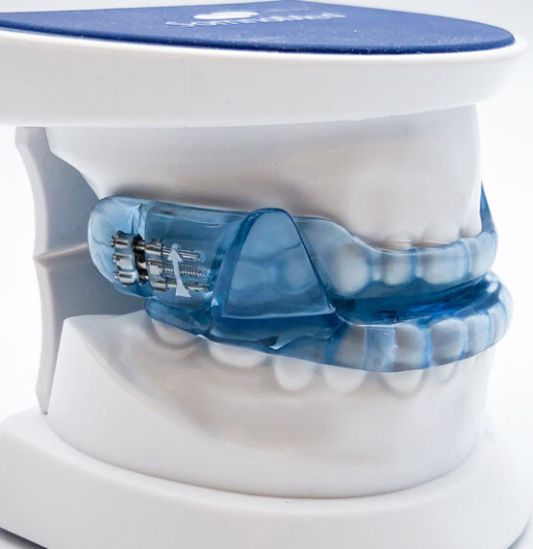
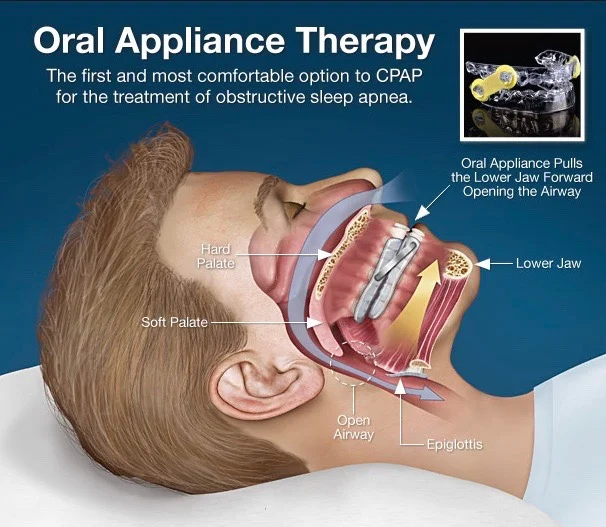
An oral appliance looks similar to a sports mouthguard or orthodontic retainer. Made from a mold of your teeth, it gently moves your lower jaw forward while you sleep, which opens space behind your tongue and helps keep your airway open. Oral appliance therapy is often recommended for mild to moderate sleep apnea, and it is also a common choice for people who cannot tolerate CPAP.
Because it is small, quiet, and does not require electricity, many patients find an oral appliance easier to travel with and easier to wear. A dentist trained in dental sleep medicine designs, fits, and adjusts the device so it works with your bite and jaw.
Positional Therapy Devices
For some people, sleep apnea is worse when sleeping on their back. Positional devices, such as wearable trainers or specially designed pillows, encourage side sleeping. They can help in select cases but are usually not enough on their own for more serious sleep apnea.
Nasal Devices and Airway Aids
Nasal strips, dilators, and similar products can improve airflow through the nose. They may help with snoring or congestion, but they typically do not treat obstructive sleep apnea by themselves. They can be a helpful add-on to another therapy.
Implanted Nerve Stimulation and Surgical Options
For patients who cannot use CPAP or an oral appliance, a physician may discuss an implanted nerve stimulation device or surgery to change the structure of the airway. These options are generally reserved for specific situations and require a specialist’s evaluation.
The Role of Airway Expansion in Sleep Apnea Treatment
Airway expansion is another area considered in certain patients with structural concerns involving the upper jaw and palate. Palatal expansion, also called maxillary expansion, is an orthodontic approach designed to widen a narrow upper jaw or dental arch. Depending on the patient’s anatomy and stage of skeletal development, this approach may influence the dimensions of the nasal floor and the space available for nasal airflow.
The upper jaw forms part of the floor of the nasal cavity. In appropriately selected patients, widening the upper jaw may increase nasal cavity dimensions and potentially improve nasal breathing. This can be particularly relevant when a narrow palate is identified during an orthodontic or airway-focused evaluation.
However, palatal expansion is not a universal treatment for obstructive sleep apnea. Its suitability depends on several factors, including:
- The width and development of the upper jaw.
- The patient’s age and skeletal maturity.
- The shape and structure of the palate.
- Existing dental and jaw alignment concerns.
- The underlying causes and severity of sleep-disordered breathing.
Children and adolescents may have different expansion options from skeletally mature adults. In adults, treatment may require different orthodontic or surgical approaches depending on the anatomy and clinical findings.
It is also important to understand that increasing palate width does not necessarily resolve sleep apnea. Patients should have an appropriate sleep evaluation, and any expansion treatment should be considered alongside established therapies such as CPAP or oral appliance therapy when indicated.
How Airway-Focused Dentistry Can Help
Traditional dental evaluations often concentrate on teeth, gums, and bite alignment. Airway-focused dentistry also considers how the structures of the mouth and jaws may relate to breathing and sleep quality. This broader perspective can help identify anatomical factors that deserve further assessment.
An airway-focused dental evaluation may consider several areas:
1. Upper and Lower Jaw Development
The size, position, and relationship of the upper and lower jaws can influence the space available for the tongue and surrounding oral structures. Certain jaw relationships may be associated with reduced airway dimensions.
2. Palate Width and Dental Arch Structure
A narrow palate or upper dental arch may be relevant when evaluating nasal breathing and overall oral anatomy. In selected cases, an orthodontic assessment may help determine whether expansion should be considered.
3. Tongue Posture and Position
The tongue plays an important role in maintaining oral and upper airway space. Its resting position, size, and movement may be considered when evaluating possible contributors to restricted breathing during sleep.
4. Nasal Breathing and Airflow
Nasal congestion, structural nasal differences, and other obstructions may affect the ability to breathe comfortably through the nose. Identifying these concerns can help determine whether an additional evaluation by an appropriate medical specialist is needed.
5. Jaw Alignment and Airway Space
The relationship between the jaws can influence tongue position and the space behind the tongue. Evaluating jaw alignment alongside other airway structures provides a more complete picture of a patient’s oral anatomy.
Airway-focused dentistry does not replace a medical sleep evaluation or diagnose sleep apnea on its own. Instead, it can complement care from sleep physicians and other specialists by identifying dental and anatomical factors that may influence treatment decisions.
CPAP vs. Oral Appliance: Which Sleep Apnea Device Is Better?
Patients often ask us to pick a winner, but the best answer is the device you will actually use every night. Here is a simple way to compare the two most common choices.
- Effectiveness: CPAP is usually the most effective option for severe sleep apnea. Oral appliances work well for mild to moderate cases and for patients who cannot tolerate CPAP.
- Comfort: CPAP involves a mask, hose, and airflow. Oral appliances sit inside the mouth and have no hose or machine.
- Portability: Oral appliances travel easily. CPAP machines need a power source and extra equipment.
- Noise: CPAP machines are quiet, but they are not silent. Oral appliances make no noise.
- Maintenance: Both need regular cleaning. CPAP needs replacement masks, filters, and tubing over time, while oral appliances need periodic dental checkups.
In some cases, the two work well together. Patients who use CPAP but struggle with high pressures may add an oral appliance to improve comfort. Your physician and dentist can coordinate to find the right combination.
Snoring is often the first sign that your airway is narrowing. If snoring is your main concern, take a look at our snoring solutions page to see how we approach it.
How to Choose the Right Sleep Apnea Device
Before you commit to any device, these questions can guide your decision.
What Does Your Sleep Study Say?
Your diagnosis and severity, measured through a home sleep test or an overnight sleep study, point to the safest and most effective starting place. A sleep physician usually makes the diagnosis, and a dentist trained in sleep medicine can then recommend and fit an oral appliance when it is appropriate.
What Is Your Anatomy Like?
Your jaw position, tongue size, tonsils, nasal passages, and bite all affect how well a device will work. A thorough exam of your airway and jaw helps predict which approach fits you best.
What Will You Realistically Wear?
Be honest with yourself and your doctor about comfort, travel, and lifestyle. A device that is slightly less powerful on paper but that you wear every night often beats a stronger one that you take off at 2 a.m.
Do You Have Other Conditions?
TMJ pain, jaw clicking, gum disease, missing teeth, and nasal blockage can influence your options. This is one reason many patients choose a practice that looks at the whole system. If jaw pain is part of the picture, our TMJ treatment page explains how jaw health and sleep are connected.
What to Expect from a Sleep Apnea Doctor in Encino
A good sleep apnea doctor in Encino does more than hand you a device. The visit should help you understand why you are having trouble breathing at night and what can be done about it. At Gorman Health & Wellness, Dr. Gorman practices integrative dental sleep medicine, which looks for the root cause of sleep-disordered breathing instead of only treating the symptoms.
A typical process includes:
- A conversation about your sleep, snoring, energy levels, and health history
- An exam of your airway, jaw, teeth, and bite
- Review of any sleep study results or coordination with your physician for testing
- A discussion of device options and what to expect from each
- A custom fitting and follow-up adjustments if an oral appliance is right for you
Follow-up is important. Your needs can change with weight, age, dental work, or health conditions, so regular checkups help keep your treatment working.
Why Patients Trust Gorman Health & Wellness
Dr. Gorman and his team have served Encino, Sherman Oaks, and the greater Los Angeles area for more than 40 years. Patients come to Gorman Health & Wellness after trying other approaches, including CPAP, and many tell us they finally feel understood. Our care is non-invasive, personalized, and focused on helping you breathe and sleep better.
Tips for Getting the Most from Your Sleep Apnea Device
- Wear your device every night, including naps and travel nights
- Keep it clean according to the manufacturer’s or dentist’s directions
- Keep follow-up appointments so adjustments can be made early
- Avoid alcohol and heavy meals close to bedtime
- Report any new jaw pain, bite changes, or discomfort to your provider
- Let your doctor know if your symptoms return
Ready to Find the Right Sleep Apnea Device?
You do not have to guess which sleep apnea device is best for you. A careful evaluation, honest conversation about your needs, and ongoing support can lead you to a treatment you can stick with. If you are in Encino or the greater Los Angeles area, contact Gorman Health & Wellness to schedule a visit with our team.
Frequently Asked Questions
1. What is the most effective sleep apnea device?
CPAP is usually the most effective option for moderate to severe sleep apnea. For mild to moderate cases, or for people who cannot tolerate CPAP, a custom oral appliance can be a strong alternative. Your sleep study and anatomy guide the best choice.
2. Can a dentist treat sleep apnea?
A physician diagnoses sleep apnea, but a dentist trained in dental sleep medicine can provide oral appliance therapy and monitor your progress. Dentists also help identify airway, jaw, and bite factors that may contribute to the problem.
3. How do I know if I need to see a sleep apnea doctor in Encino?
Consider a visit if you snore loudly, wake up gasping, feel tired despite a full night in bed, or if your partner notices breathing pauses. You should also come in if CPAP is uncomfortable and you want another option.
4. Are oral appliances comfortable to wear?
Most patients adjust within a few weeks. A custom fit makes a big difference, and your dentist can make changes if you feel pressure or soreness. Report any persistent jaw or tooth discomfort.
5. How long does it take to feel better after starting treatment?
Some people notice less snoring and better energy within days to weeks. Results vary, and your provider will check your progress and adjust as needed.
6. Do I need a sleep study before getting a sleep apnea device?
In most cases, yes. A home sleep test or overnight study confirms the diagnosis and its severity so your device choice is safe and appropriate.
